.png)


 to order a call
Water pH and EC: How to Measure, Adjust, and Avoid Power Lockouts

What is pH in simple words and why nutrition depends on it
pH shows how acidic or alkaline water or a solution is on a scale of 0–14. Neutral water has a pH of 7, lower is more acidic, higher is more alkaline. For Grover, this is not a “chemistry theory” but a guide to the availability of elements: at different pH ranges, some substances are easily absorbed, while others are almost blocked.
That is why a situation often occurs: you have added fertilizer, but the leaves still turn yellow or spots appear. The problem is not always in the dosage - sometimes the plant simply cannot “eat” normally, because the pH has gone down. This is nutrient lockout: the elements are present in the substrate/solution, but they become inaccessible.
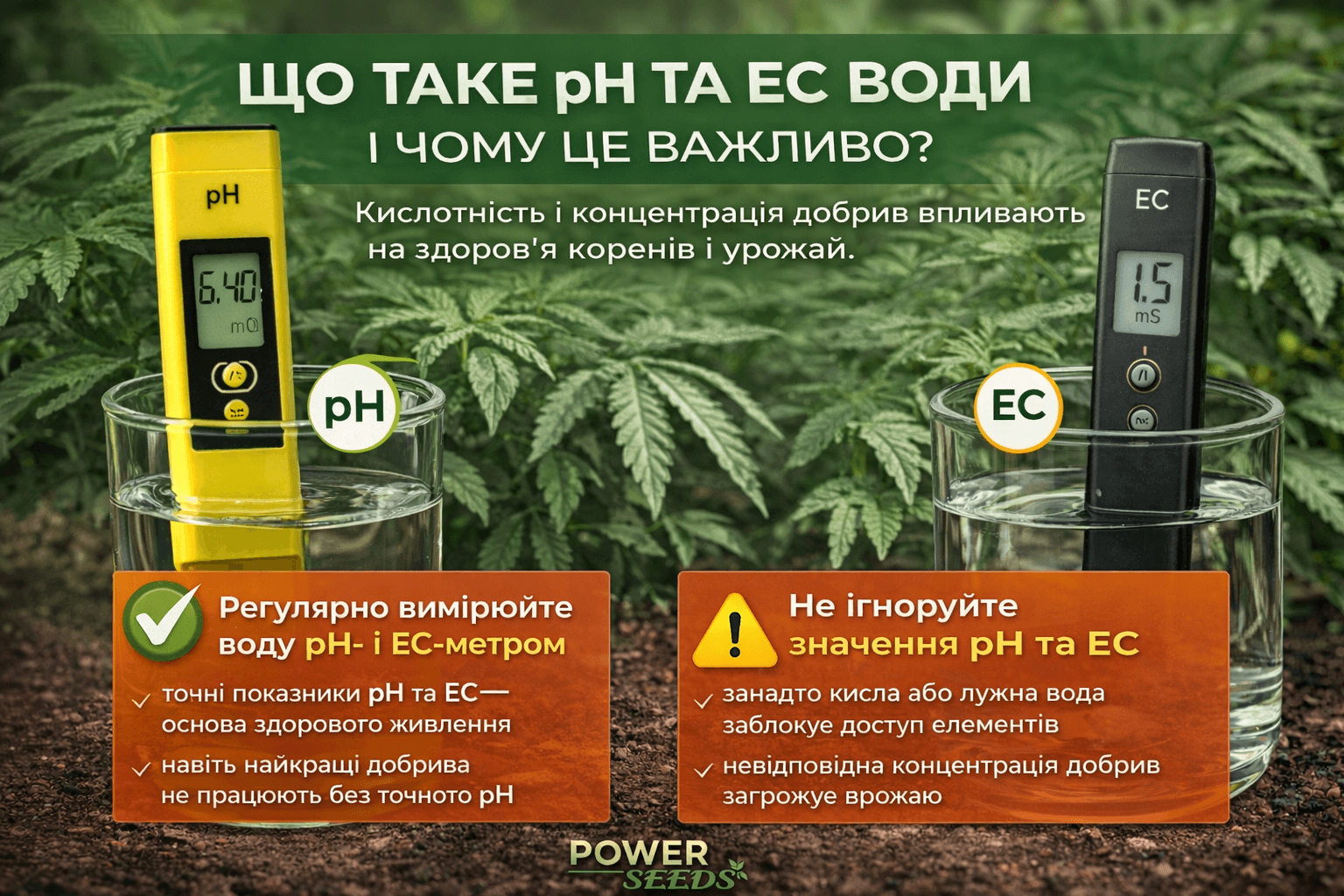
What is EC and why is it needed if there is already pH?
EC (electrical conductivity) is the conductivity of the solution, i.e. an indirect indicator of how “saturated” it is with salts/fertilizers. In human terms: EC shows the strength of your nutrition. Even if the pH is ideal, too high an EC can easily burn the roots and cause stress, and too low an EC can cause starvation and poor growth.
It is important that pH and EC work in tandem: first you prepare the solution (water → fertilizers → check EC), and only then bring the pH to the correct limits. If you do the opposite, the fertilizers will change the acidity again, and you will start “chasing” the numbers.
Optimal pH ranges for soil, coco and hydroponics
There is no one universal number, as different environments “hold” acidity differently. Use these ranges as a healthy standard, not as a fanatical “to the hundredth” rule.
Soil
For most soil cycles, a comfortable base is pH 6.2–6.5 during vegetation and 6.3–6.8 during flowering. A slight increase during flowering is logical: the plant consumes phosphorus and potassium more actively.
Coco / hydroponics
In coco and hydra, the working limits are lower: during growth, they often keep the pH at 5.5–5.8 , and during flowering, at 5.8–6.2 . Here, the environment reacts faster, so stability and small corrections are your best friends.
How to measure pH correctly: 3 ways and which one should a beginner choose?
Measuring pH is not a “ritual,” but a habit. The difference between a beginner and a stable grower is often not in secret additives, but in the fact that the second one regularly checks the basics.
1) Test drops
Cheap, simple, no batteries. The downside is that the accuracy is lower than that of the device. But for a start, it's a decent option if you don't want to spend a lot of money right away.
2) Stripes
Fast and mobile, but again, accuracy depends on the scale and lighting. Good for quick checks, but not always convenient for regular routine.
3) Electronic pH meter
The most convenient in the long run. Yes, it needs to be calibrated and the electrode needs to be stored properly, but this option is the one that best “removes the headache” when you want a repeatable result in each cycle.
How to adjust pH without a swing: a step-by-step guide
If you only remember one pattern, remember this one. It reduces chaos and saves you a lot of stress.
Step 1. Pour water, let it stand (if it is tap water) and bring to operating temperature.
Step 2. Add fertilizers/additives in the correct order, mix.
Step 3. Check the EC (to understand the “strength” of the solution).
Step 4. Check the pH and only then adjust pH Up or pH Down in small doses.
Step 5. Wait 1–2 minutes, stir, measure again.
Step 6. Write down how many milliliters of concealer you used for your volume - it will be easier next time.
An important rule: do not pour a lot at once. Sharp corrections are the main cause of “swings”, when today the pH is 5.5, tomorrow 6.7, the day after tomorrow again 5.6. The plant loves stability, not perfect numbers per minute.
Typical symptoms of pH and EC problems and how to distinguish “starvation” from blockage
The most insidious thing about pH problems is that they masquerade as deficiencies. You see yellowing, dry ends, spots, and your hand reaches out to “add more fertilizer.” But if the cause is pH, then more fertilizer will often only make things worse (because it will raise the EC and kill the root).
This is what most often suggests that the problem is in the pH/EC: the leaves turn yellow despite normal feeding, the tips “burn”, growth becomes sluggish, and the plant looks like it is “both hungry and overfed” at the same time. In such scenarios, it is better to act calmly: check the pH of the solution, check the pH of the drainage (runoff) in the soil/coco, assess the EC and only then adjust.
How to Keep Your pH Stable Throughout Your Cycle: A Routine That Actually Works
Consistency isn't about measuring everything every 2 hours. It's about simple regularity. If you check your pH/EC at least once every few waterings and keep brief notes, you're already ahead of most beginners.
In the soil, things that “buffer” the environment are additionally saved: high-quality substrate, normal drainage, and no overfilling. In coco/hydra, the key is the cleanliness of the system, aeration, and control of the solution temperature. And yes, this directly affects how your autoflowers will work in a fast cycle.
A little practice for the Power Seeds store: what to take to the grower “as a pair” with seeds
If you are looking for autoflowering cannabis seeds or autoflowering feminized seeds , budget for two more things: a simple pH meter and a basic EC meter. This is a case where a small purchase gives a bigger boost to your results than “another jar of supplement.”
And to immediately choose genetics for your style - here are some useful sections
• Auto-fem sativa — when you want a more “energetic” profile and a fast growth rate.
• Auto-fem indica — when you need more compact bushes and a calmer character of the variety.
To put it simply: pH determines whether a plant can absorb elements, and EC determines how much of these elements you are actually giving it. When both indicators are within adequate limits, everything else (light, regime, genetics) starts to work “as it should”. And when you ignore the base, strange symptoms appear, chaotic watering and loss of pace.
Make a little routine for yourself: mix the solution → check the EC → check the pH → write it down. It doesn’t take much time, but you will feel the difference already on the next cycle.
Disclaimer: The material is for informational purposes only and is not a solicitation to violate the law. Please comply with the laws of your jurisdiction.
