.png)

 to order a call
10 key parameters for creating optimal conditions for growing cannabis in the open field.
Growing cannabis outdoors is a great way to get healthy and strong plants.


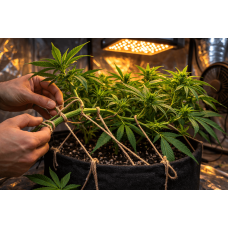
Supercropping is a plant shaping technique that allows you to control the height, light distribution, and crown structure of your plants. There are several variations of this technique, but the approach, often called “Tie & Train,” is simple and effective. It can be compared to a scrog, but without the use of a net. The basic idea is to create a flat, horizontal crown, which allows you to bring the light source as close as possible and reduce the loss of intensity over distance.
This is especially important in small spaces or when working with limited lighting power. When all the tops are at the same level, the light is distributed evenly, and the plant uses its potential more balancedly.
Classical topping involves trimming the top to stimulate lateral growth. This is one way to get several main shoots instead of one central one. However, after pruning, vertical growth continues, and the plant still tends to dominate one or more shoots.
The Tie & Train method works differently. Instead of removing the top, it is temporarily fixed in a bent position. Thanks to hormonal restructuring, the plant redistributes energy to the side nodes. As a result, more shoots of equal strength are formed, and the internodes are often located closer to each other.
From practical experience, it can be seen that when fixing the top, the plant reacts quickly to a change in position. Within a few days, the top shoot tries to return to the light, but at the same time the side branches become active and begin to grow intensively. It is at this moment that the future crown structure is laid.
Sometimes before fixing, the stem is slightly kneaded with your fingers to reduce its rigidity. Light twisting between your fingers helps the stem become more flexible and reduces the risk of a sharp break. It is important to proceed with caution: the goal is to weaken the internal structure, not to damage it completely. If the tissue remains intact, the plant usually recovers quickly.
After fixing the top to the base, the plant gradually takes on a new shape. After a week, you can observe how the central shoot restores its vertical orientation, but no longer completely dominates. This period often determines how even the future canopy will be.
When the side shoots begin to develop actively, they are gradually spread out in different directions. The strongest branches are usually fixed closer to the edges of the container so that the weaker shoots can catch up with them in height. This approach allows you to form a wide and flat crown without sharp differences in height.
At this stage, it is important to regularly check the fixation, as the stems thicken over time. The material for tying should be soft enough not to pinch the tissues.
When comparing different shaping methods, it is often noticeable that plants formed by the fixation method without pruning have a denser arrangement of nodes and a more even distribution of shoots along the stem. Topping can contribute to the width of the crown, but is sometimes accompanied by a larger interval between nodes and additional energy expenditure for recovery after pruning.
At the same time, it is worth noting that the final result depends not only on the technique, but also on genetics and environmental conditions. Plants grown from hemp seeds can exhibit natural differences even with the same formation method.
The main goal of supercropping is to obtain the most even plane of the tops. When all the growth points are at the same height, the light flux is used more efficiently. This is especially noticeable when working with medium-power lamps, where every centimeter of distance matters.
In the final stage of development, a well-formed plant looks balanced, with evenly lit tops. Such a structure allows you to better control the process and predict the result.
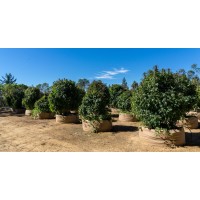
Growing cannabis outdoors is a great way to get healthy and strong plants.
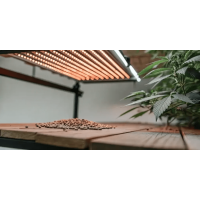
In the world of cannabis cultivation, there have always been small rituals that are spoken about quietly, but with a twinkle in their eyes. One of these is the so-called “3 days of complete darkness before harvest”.
Заполните форму
